This cartographic animation comes from wunderground.com, one of my favorite weather sites. It animates up to the last 6 radar maps so you can see which way a storm is moving. This is a screen capture, so you will need to click on the link to see the animation.
Portolan charts were highly stylized and imprecise charts, but they did reflect coastlines and ports and were useful for navigating smaller bodies of water. This chart depicts the Mediterranean Sea from an unusual orientation for most of us.
This Marshall Islands stick chart is a very sophisticated form of mental map. The cultures that made maps like this used them to navigate tremendous distances over open water.
This index value plot from the University of Missouri Economics Department shows the value of residential construction and all construction combined. An index value plot doesn't show the actual value, but some kind of index of it.
This bivariate choropleth map analyzes John Kerry's vote share and the population of an area in the 2000 election. As the cartographer says "Places that are green are high in Kerry votes but low in population, and places that are purple are simply high in population." A combination of the two colors represents areas high in both population and Kerry votes.
This bilateral graph shows the historical performance of the New Asia Growth Fund from Pacific Capital Funds. Investment companies are required to make such performance information public.
This is a combination PLSS and civil township map of western Iowa. PLSS data are displayed as 36-square grids surrounded by a red line, and civil township information is displayed using different colors.
This cartogram shows the world with thousands of annual aircraft departures substituted for land area. I found this on worldmapper.org, the website of Danny Dorling. He has many fascinating cartograms on his site.
This is a very interesting isohyet map from the Hong Kong Observatory. It automatically updates by the hour, and the page links to previously generated maps as well. The observatory does a very good job of critical cartography on itself, and points out clearly that this map does not necessarily show all rain, and that all areas inside the precipitation boundaries may not be receiving rain.
These are population profiles for Kenya, the U.S., and Italy. From right to left, they represent the change as a nation develops, from high birth and mortality rates (growing population) to low birth and mortality rates (shrinking population).
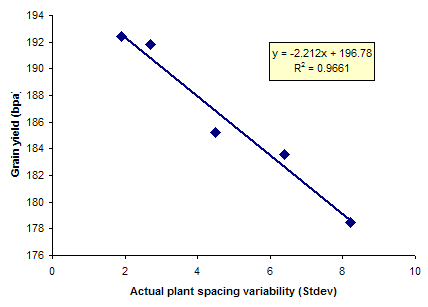
This scatterplot shows the relationship between how close together corn plants are seeded in a field and the resulting yields of that field. A lot of science goes in to large-scale agriculture.
This is a Doppler Radar image of Hurricane Frances in August of 2004. I lived through this hurricane (and without electricity for 2 weeks after it). The top of the eyewall passed just north of Stuart, the town I live in.
This map is a histogram depicting the average height of the populations of various European countries. It tells us that of the countries shown, the Netherlands has the tallest population on average, followed by the U.K., Sweden, Germany, Italy, and France. If we do not assume that the data is accurate, it might be a propaganda map as well, especially if the Netherlands is trying to woo would-be NBA players away from Italy and France.